
A musical instrument is an instrument created or adapted to make musical sounds. In principle, any object that produces sound can be a musical instrument—it is through purpose that the object becomes a musical instrument. The history of musical instruments dates to the beginnings of human culture. Early musical instruments may have been used for ritual, such as a trumpet to signal success on the hunt, or a drum in a religious ceremony. Cultures eventually developed composition and performance of melodies for entertainment. Musical instruments evolved in step with changing applications.
The date and origin of the first device considered a musical instrument is disputed. The oldest object that some scholars refer to as a musical instrument, a simple flute, dates back as far as 67,000 years. Some consensus dates early flutes to about 37,000 years ago. However, most historians believe that determining a specific time of musical instrument invention is impossible due to the subjectivity of the definition and the relative instability of materials used to make them. Many early musical instruments were made from animal skins, bone, wood, and other non-durable materials.
Musical instruments developed independently in many populated regions of the world. However, contact among civilizations caused rapid spread and adaptation of most instruments in places far from their origin. By the Middle Ages, instruments from Mesopotamia were in maritime Southeast Asia, and Europeans played instruments from North Africa. Development in the Americas occurred at a slower pace, but cultures of North, Central, and South America shared musical instruments. By 1400, musical instrument development slowed in many areas and was dominated by the Occident.
Musical instrument classification is a discipline in its own right, and many systems of classification have been used over the years. Instruments can be classified by their effective range, their material composition, their size, etc. However, the most common academic method, Hornbostel-Sachs, uses the means by which they produce sound. The academic study of musical instruments is called organology.
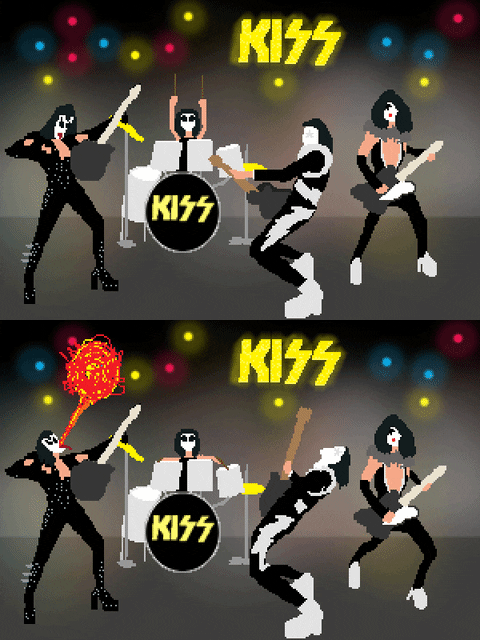
A music genre is a conventional category that identifies some pieces of music as belonging to a shared tradition or set of conventions.[1] It is to be distinguished from musical form and musical style, although in practice these terms are sometimes used interchangeably.[2][not in citation given] Recently, academics have argued that categorizing music by genre is inaccurate and outdated.[3]
Music can be divided into different genres in many different ways. The artistic nature of music means that these classifications are often subjective and controversial, and some genres may overlap. There are even varying academic definitions of the term genre itself. In his book Form in Tonal Music, Douglass M. Green distinguishes between genre and form. He lists madrigal, motet, canzona, ricercar, and dance as examples of genres from the Renaissance period. To further clarify the meaning of genre, Green writes, "Beethoven's Op. 61 and Mendelssohn's Op. 64 are identical in genre – both are violin concertos – but different in form. However, Mozart's Rondo for Piano, K. 511, and the Agnus Dei from his Mass, K. 317 are quite different in genre but happen to be similar in form."[4] Some, like Peter van der Merwe, treat the terms genre and style as the same, saying that genre should be defined as pieces of music that share a certain style or "basic musical language."[5] Others, such as Allan F. Moore, state that genre and style are two separate terms, and that secondary characteristics such as subject matter can also differentiate between genres.[6] A music genre or subgenre may also be defined by the musical techniques, the style, the cultural context, and the content and spirit of the themes. Geographical origin is sometimes used to identify a music genre, though a single geographical category will often include a wide variety of subgenres. Timothy Laurie argues that since the early 1980s, "genre has graduated from being a subset of popular music studies to being an almost ubiquitous framework for constituting and evaluating musical research objects".[7]
Among the criteria often used to classify musical genres are the trichotomy of art, popular, and traditional musics.
Alternatively, music can be divided on three variables: arousal, valence, and depth.[3] Arousal reflects the energy level of the music; valence reflects the scale from sad to happy emotions, and depth reflects the level of emotional depth in the music.[3] These three variables help explain why many people who like similar songs from different traditionally segregated genres.[3]


0 comments:
Post a Comment